Analysis of the ACT Domestic and Family Violence Risk Assessment and Management Framework (DFV-RAMF)
- 1 day ago
- 3 min read
Updated: 14 hours ago
Executive Summary
This White Paper evaluates the ACT Domestic and Family Violence Risk Assessment and Management Framework (DFV-RAMF) against established international standards and internal government mandates.
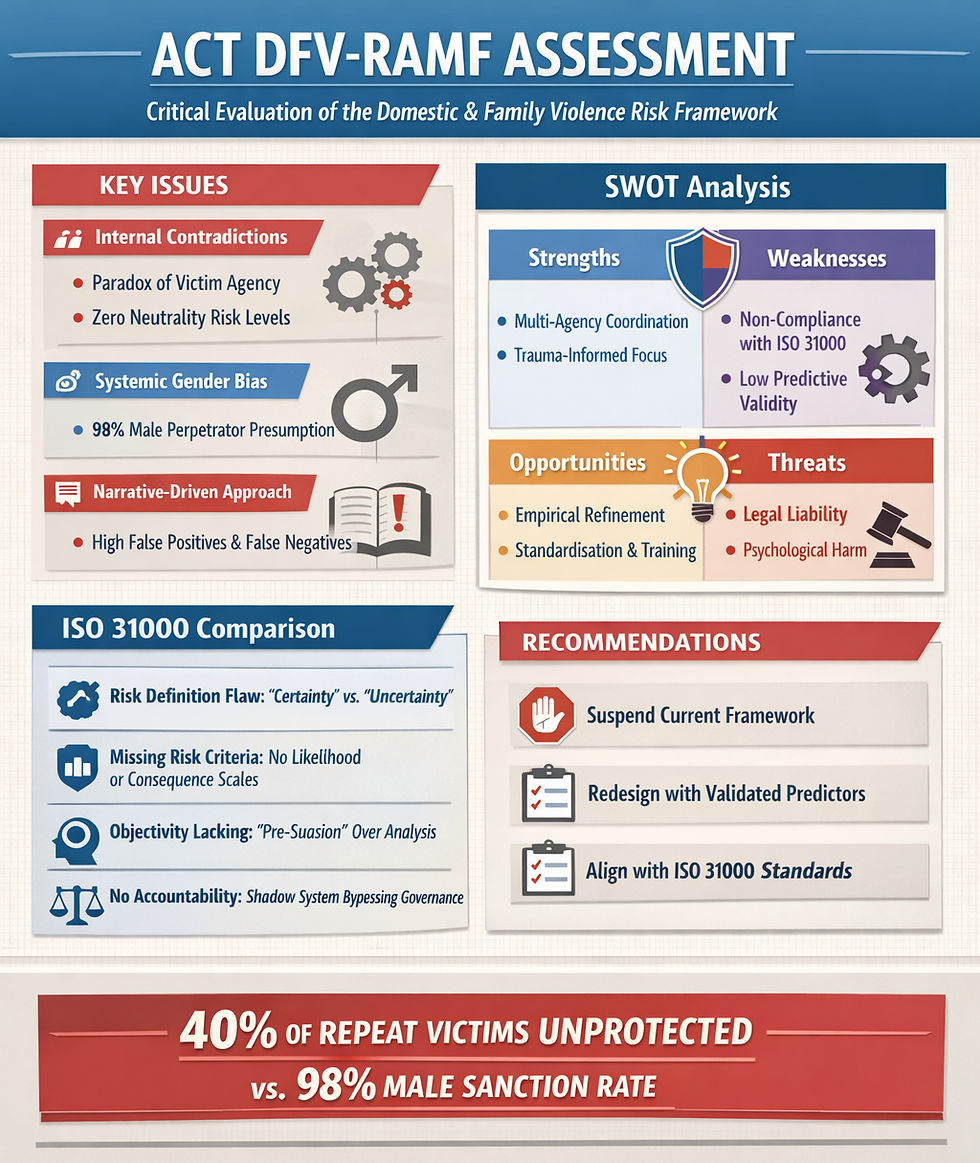
While intended to provide a coordinated response to family violence, the framework exhibits significant internal inconsistencies, systemic gender biases, and a fundamental departure from the ISO 31000:2018 risk management standards mandated by the ACT Government.
The current framework functions as a narrative-driven persuasion model rather than an objective analytical instrument, resulting in high rates of both false positives and false negatives [AIC FVRAT Assessment].
1. Internal Methodological Inconsistencies
The DFV-RAMF contains core procedural contradictions that undermine the reliability of its outputs:
Paradox of Victim Agency: The framework establishes that "victims know their perpetrator best" and are the most accurate predictors of their own safety [ACT Domestic and Family Violence Risk Assessment and Management Framework]. However, it simultaneously mandates that practitioners "discuss the nature and dynamics of domestic violence" if a victim "minimises" the violence, essentially instructing practitioners to override the victim’s account if it does not match the framework's predetermined narrative.
The Zero-Neutrality Risk Spectrum: Unlike standard risk models, the DFV-RAMF provides no pathway to a "Low Risk" or "No Risk" classification. By asserting that "all domestic and family violence should be considered a risk," the tool collapses the spectrum of human behaviour into a mandatory hierarchy of danger ("At risk", "Elevated", or "High risk"), which prevents professional neutrality.
Narrative vs. Structure: The framework replaces structured risk analysis with "narrative fragments" that describe historical incidents without the required cause–event–consequence statements necessary for defensible risk management.
2. SWOT Analysis of the DFV-RAMF
Strengths | Weaknesses |
Integrated Multi-Agency Structure: Facilitates information sharing between ACT Policing, CYPS, and specialist services. | Non-Conformance with ISO 31000: Lacks defined consequence and likelihood scales and fails to address uncertainty objectively [CMTEDD Risk Management Framework and Policy]. |
Trauma-Informed Intent: Prioritises the safety of victims and children as a paramount concern. | Low Predictive Validity: AIC research shows the primary assessment tool is only "marginally better than chance" at predicting repeat violence [AIC FVRAT Assessment]. |
Systemic Gender Bias: Triage data shows a 98% male perpetrator identification rate, indicating a structural presumption of male guilt. | |
Opportunities | Threats |
Empirical Refinement: Redesigning the tool to focus on the 10 individually predictive items identified by the AIC to improve accuracy [AIC FVRAT Assessment]. | Legal and Human Rights Liability: High risk of false positives leading to quasi-criminal sanctions (eviction, loss of child contact) without findings of fact. |
Standardisation: Fully aligning the framework with the CMTEDD Enterprise Risk Management Framework to restore accountability. | Psychological Harm: Increased suicide risk and psychological distress for individuals labeled "high risk" via unvalidated heuristics. |
Accredited Training: Moving away from informal training toward ASQA-accredited practitioner competencies. | False Negatives: A 40% failure rate in identifying cases where repeat violence actually occurs, leaving victims unprotected [AIC FVRAT Assessment]. |
3. Comparison Against ISO 31000:2018 Standards
The ACT Government mandates that risk management be designed in accordance with AS ISO 31000:2018 [CMTEDD Risk Management Framework and Policy]. The DFV-RAMF fails this mandate in several critical areas:
Definition of Risk: ISO 31000 defines risk as the "effect of uncertainty on objectives" [ISO 31000:2018], [CMTEDD Risk Management Framework and Policy]. The DFV-RAMF treats risk as a predetermined certainty, thereby failing to analyse or manage the actual uncertainty of future events.
Risk Criteria: ISO 31000 requires an organisation to define criteria to evaluate the significance of risk, specifically consequence and likelihood [CMTEDD Risk Management Framework and Policy]. The DFV-RAMF lacks these scales entirely, relying instead on subjective "Professional Judgement" and scripted prompts.
Objectivity vs. "Pre-suasion": ISO 31000 principles require risk management to be inclusive and based on the "best available information" while acknowledging limitations and biases. The DFV-RAMF encourages "suggestive recall" and "pre-suasion," where practitioners are instructed to cognitively reframe client accounts to fit the framework, which violates the principle of using objective, untainted information.
Accountability and Governance: The CMTEDD framework requires structured risk registers, assurance maps, and clear risk ownership [CMTEDD Risk Management Framework and Policy]. The DFV-RAMF operates as a "shadow" system that bypasses these whole-of-government oversight mechanisms.
Conclusion and Recommendations
The ACT DFV-RAMF is currently methodologically flawed, and by most measures, it is not fit for purpose. It prioritises ideological narrative alignment over the rigorous, evidence-based assessment of uncertainty required by ISO 31000. This lack of rigour creates a system that fails to protect 40% of victims in repeat violence cases while simultaneously imposing severe, untested sanctions on a triaged population that is 98% male.
Recommendations
Immediate Suspension: Suspend the use of the current narrative-based prompts and unvalidated heuristics.
Full Redesign: Rebuild the tool using the 10 predictive items validated by the AIC to ensure acceptable predictive validity.
Mandatory Compliance: Enforce strict alignment with the ACT Government ERM Framework and ISO 31000, including the implementation of consequence/likelihood matrices and formal risk registers.



Comments