Critical Analysis Report: Internal Inconsistencies and Biases in the ACT DFV-RAMF
This report examines the ACT Domestic and Family Violence Risk Assessment and Management Framework (DFV-RAMF) based on independent expert reviews, criminological studies, and the framework’s own internal directives. Significant internal contradictions exist regarding victim agency, the application of gendered heuristics, and the reliability of its "evidence-based" claims. These issues create a system that prioritizes predetermined narrative alignment over objective risk analysis.
1. Internal Methodological Inconsistencies
The DFV-RAMF contains several self-contradicting directives that undermine the integrity of its assessments:
Victim Reliability vs. Practitioner Intervention: The framework asserts that "victims know their perpetrator best and can often accurately predict their own level of safety and risk". However, it simultaneously directs practitioners to "discuss the nature and dynamics of domestic violence" if a victim "minimises the violence". This creates a logical paradox where a victim is considered the ultimate authority only when their account aligns with the framework's predetermined expectations.
Neutrality vs. Pre-determined Risk: While the framework claims to support a "coordinated and consistent response," it provides no pathway for a "Low Risk" or "No Risk" classification: By stating that "all domestic and family violence should be considered a risk," it forces every individual triaged into a hierarchy of danger ("At risk", "Elevated risk", "High risk"), effectively removing professional neutrality from the outset.
Narrative Fragments vs. Structured Statements: Although presented as a risk management tool, experts note the framework uses "narrative fragments" describing past incidents rather than the structured cause–event–consequence statements required by international standards like ISO 31000.

2. Systemic Gender and Narrative Biases
The sources identify deep-seated biases in both the design and the execution of the framework:
Gendered Heuristics: The framework explicitly identifies its focus as "men’s violence against women". Expert reviews argue this results in systemic bias, noting that approximately 98% of those triaged by the ACT’s Family Violence Safety Action Program (FVSAP) are identified as male perpetrators, often regardless of the specific dynamics of the individual case.
Structural Confirmation Bias: The DFV-RAMF instructs practitioners to "help victims to name it" when they do not recognize their experience as violence. This has been labeled by experts as "authority-driven pre-suasion" and "suggestive recall," where the assessor is mandated to cognitively reframe the client's lived experience until it fits the framework’s ideological model.
The "Every Woman" Directive: Screening protocols mandate asking "every woman who uses the service" set questions about violence 13. Experts argue this universal inquiry, combined with a lack of similar protocols for men, embeds a leading frame that subtly signals the desired answer is disclosure of victimhood.
3. Evidence-Base and Predictive Validity Gaps
There is a marked disconnect between the framework’s claims of being "evidence-based" and its actual performance:
Low Predictive Accuracy: A study by the Australian Institute of Criminology (AIC) found that the ACT’s risk assessment tool was only "marginally better than chance" at predicting repeat domestic violence within a six-month period.
Validation Failures: The AIC study highlighted a 40 percent false negative rate, where cases classified as "low risk" resulted in further violence, potentially leaving victims unprotected.
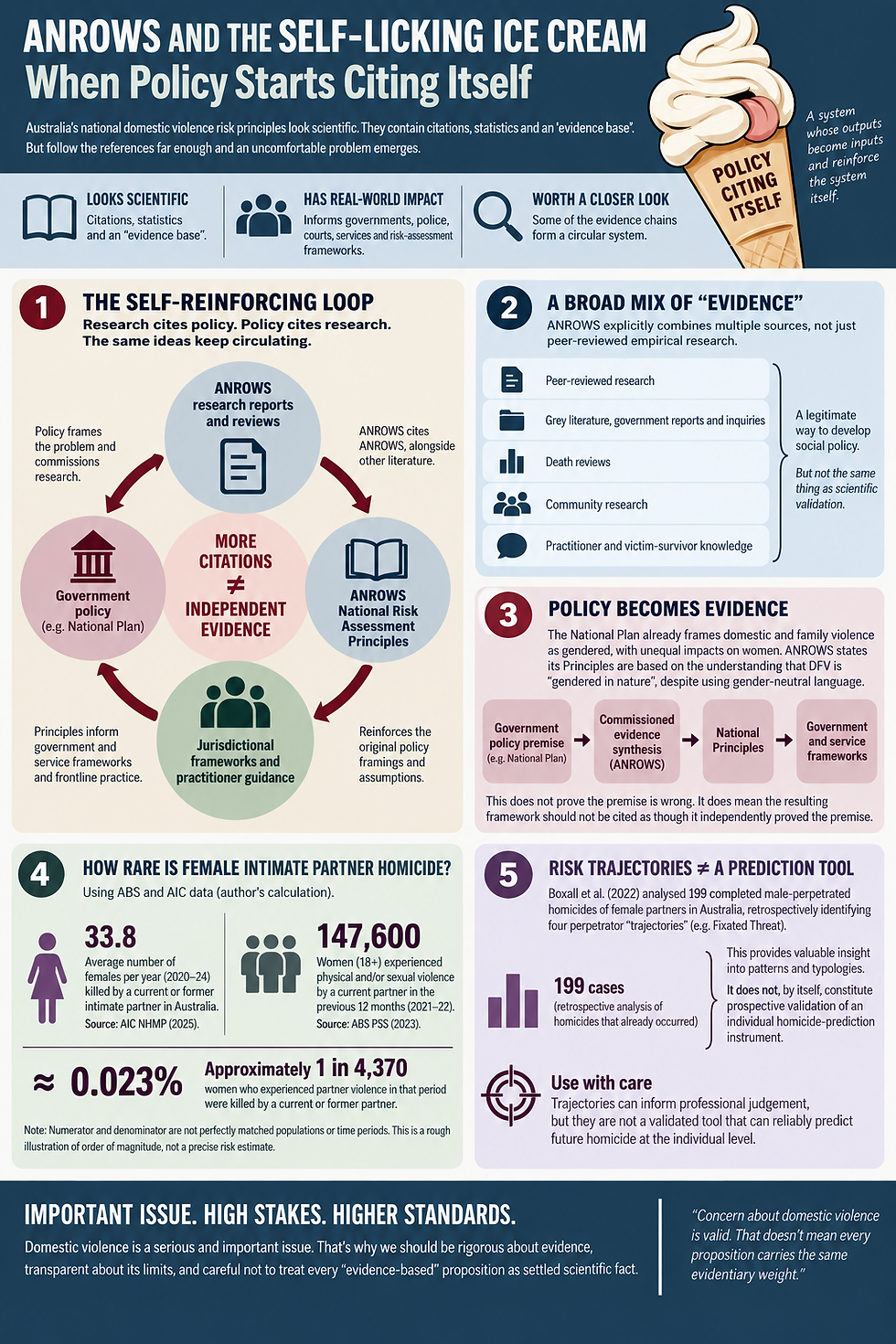
Policy Synthesis vs. Empirical Tools: Experts contend that the "key risk factors" used in the framework are drawn from policy syntheses (e.g., ANROWS and MARAM) rather than peer-reviewed, empirically validated assessment instruments.
4. Legal and Ethical Consequences
The internal inconsistencies and biases of the DFV-RAMF result in significant real-world harms:
False Positives and "Consent" Orders: The high risk of false positives for men leads to quasi-criminal sanctions—such as eviction or loss of child contact—often via Family Violence Orders (FVOs) resolved by consent without admissions.
Psychological Impact: Because the system labels individuals as "high-risk" using suggestive scripts, it can increase psychological distress and suicide risk, a finding echoed by the Royal Commission into Defence and Veteran Suicide regarding contact with the legal system. 1
Conclusion
The ACT DFV-RAMF operates as a persuasion model rather than an analytical instrument. 21 By instructing practitioners to override client accounts and collapsing the risk spectrum into a hierarchy of danger, the framework violates the fundamental risk management principle of addressing uncertainty. 22 Consequently, it is described by experts as methodologically flawed and not fit for purpose.


Comments