Shenzhen, “Leftover Women,” and the Economics of Modern Mating:What China Teaches Us About Market Forces, Incentives, and Misandry
- Apr 22
- 4 min read
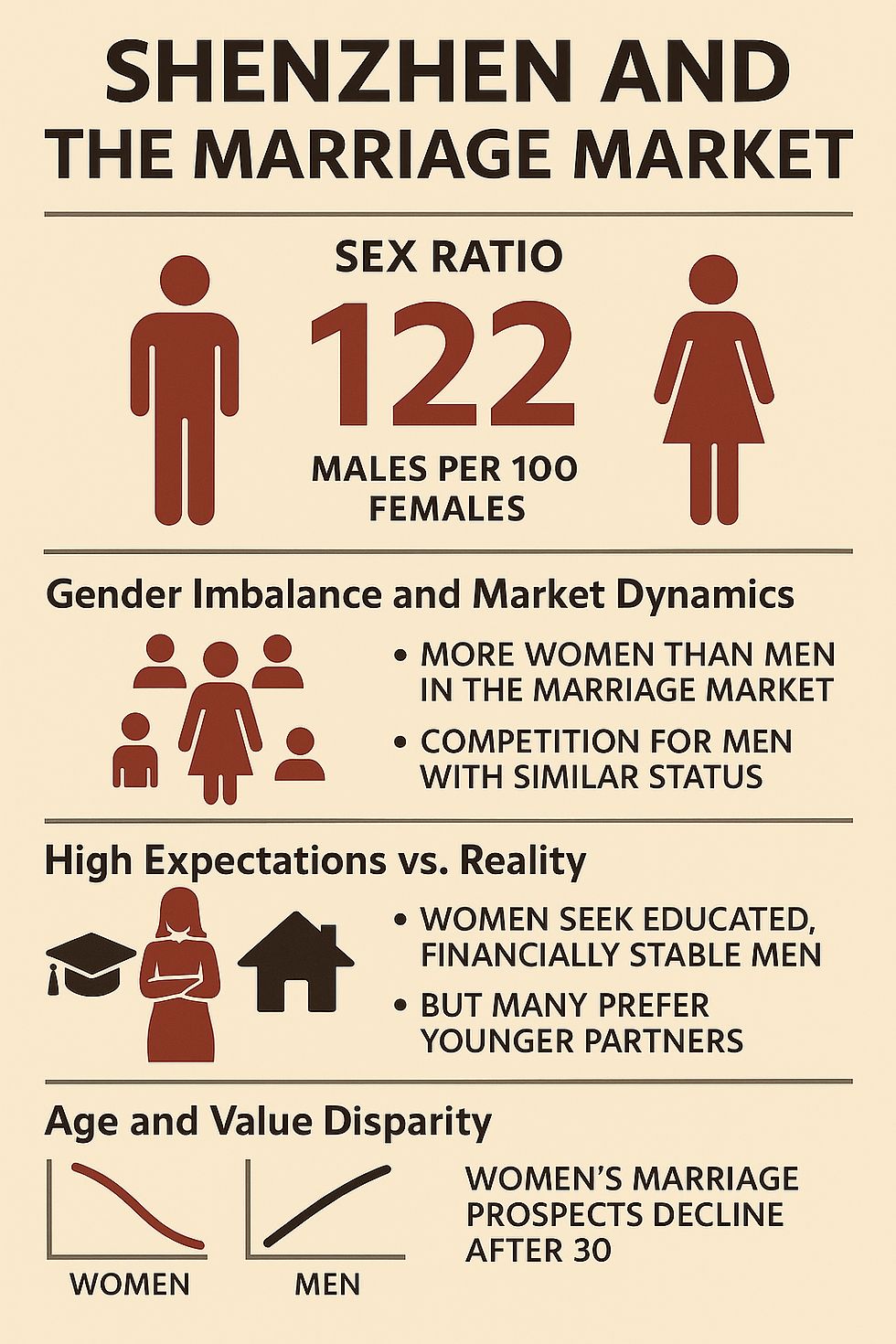
Shenzhen is one of the wealthiest, fastest-growing cities in China — a magnet for young professionals, tech workers, and migrants chasing opportunity. On paper it looks like a dating paradise for women: the official sex ratio is about 122 men for every 100 women, one of the largest male-heavy imbalances in the country.
Yet countless media pieces, documentaries, and viral videos portray Shenzhen as a place where professional women “can’t find a husband,” “cry in despair,” and “have no men left to date.” Some even throw around the absurd statistic that the marriage market is “nine women for every man.”
The population numbers don’t support that.
But the lived reality does — and it reveals a set of social and economic incentives that echo the structural arguments made in The Misandry Bubble.
This is not a Chinese issue. This is a modern, urban, Western-model mating market issue. Shenzhen is simply the clearest laboratory case.
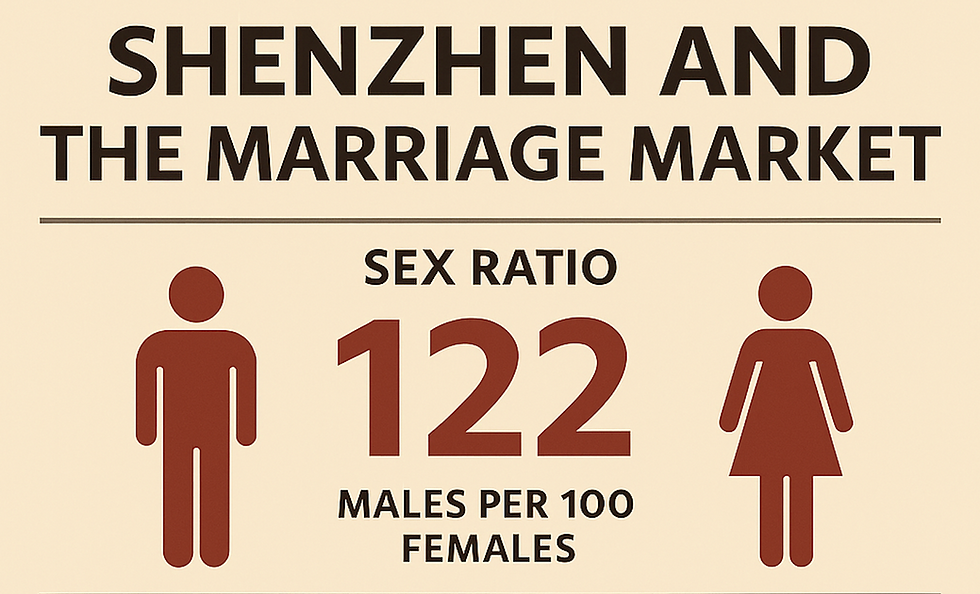
1. The Demographics: More Men, Fewer Marriageable Men
Shenzhen has a huge population of male migrant workers in construction, tech manufacturing, and service industries. They inflate the male-to-female ratio, but they aren’t part of the “marriage market” for highly educated urban women. These women are typically:
• University educated
• Earning well above the national average
• Financially independent
• Urban hukou holders
• Career-driven and time-poor
• Reluctant to “marry down”
The male cohort that matches this group — educated, urban, property-owning, and professionally stable — is much smaller. And those men know it.
This mismatch is exactly the kind of incentive distortion described in The Misandry Bubble: when traditional expectations persist but the market pool shrinks, the pressure falls asymmetrically on men and women.
2. Hypergamy Meets Economics: Women’s Preferences Collide with Supply Constraints
Across cultures, women tend to prefer men who are equal or higher in:
• Education
• Income
• Social stability
• Property ownership
• Maturity and life direction
This preference isn’t judgmental — it’s statistical.
But in cities like Shenzhen, it creates a bottleneck.
Highly accomplished women aim for the same small group of high-status men. Meanwhile, those men face a flood of options, particularly younger women from both Shenzhen and other cities. This mirrors the “market-value divergence” described in The Misandry Bubble: the older and more successful a woman becomes, the narrower the pool of acceptable partners becomes, while the pool available to high-status men widens.
3. Age and Market Value: The Unequal Curve
In modern urban dating markets:
• Women’s perceived market value peaks in their early 20s
• Men’s perceived market value peaks in their 30s and 40s (after career and assets accumulate)
Shenzhen amplifies this dynamic:
• Sky-high real estate costs mean men with property are prized
• Men in their early 30s who own an apartment can date across all age brackets
• Women in their mid-30s face fierce competition from younger women who ask for less
This is classic Misandry Bubble incentive structure: society tells women they can “have it all,” but never tells them about the opportunity cost or the market realities that come in their 30s. Meanwhile, men who succeed early are rewarded with abundant choice and minimal pressure.
4. The Emotional and Social Fallout
The videos and interviews coming out of Shenzhen reveal a common pattern:
• Older single women report repeated rejection
• Many feel they “did everything right” but now face limited options
• They lower standards — no dowry, no property demands, co-ownership offers
• Still, few men are interested
• Matchmaking events are filled with women; eligible men rarely attend
• Many women express anxiety, desperation, or regret
This is not misogyny.
It’s market feedback.
The dating market is brutally honest.
It doesn’t care about degrees, job titles, or intentions.
It operates on supply, demand, and incentives — the same principles that govern economics.
5. The Misandry Bubble Connection: Incentives Create Outcomes
The Misandry Bubble argues that modern societies inadvertently create systems where women:
• Are told they don’t need men until they hit their 30s
• Are told men should “wait” for them
• Are taught to look upward but not sideways
• Are shielded from early accountability
• Are encouraged to delay family formation for career
• Expect high-value men to be abundant and waiting
• Are rarely informed that dating markets evolve, and rapidly
At the same time, men:
• Face rising expectations and decreasing returns
• Are blamed for women’s choices and timelines
• Are shamed for dating younger women
• Are expected to absorb the burden of providing property and stability
• Are told their preferences are “immature” even though they align with evolutionary and economic logic
Shenzhen makes this dynamic visible because its population is so large and its data so clear.

6. Why This Matters for FamilyLawReform.com.au
Australia’s family law system, media narratives, and cultural messaging increasingly mirror these same structural tensions:
• Delayed marriage
• Delayed childbearing
• Career-first social models
• Hypergamous expectations
• High property costs
• Divergence between male and female incentives
• Demonisation of men who don’t meet shifting expectations
• Women blindsided by market realities at 32–40
• Courts structured around outdated assumptions
Understanding Shenzhen helps Australians see what’s coming here.
Urban centres with high education and high cost of living (Sydney, Melbourne, Canberra) are already replicating these same marriage-market patterns — high-value men have choice, and high-value women are frustrated by the shrinking pool of peers.
This directly affects:
• Marriage rates
• Divorce risk
• Custody patterns
• Family formation
• Policy design
• Social cohesion
Conclusion: The Market Always Wins
Shenzhen isn’t a city of “leftover women.”
It’s a city that shows what happens when social narratives collide with economic incentives.
The population has more men than women — but the marriage market has more highly educated, highly selective women than men who meet their criteria.
This disparity produces:
• frustration
• resentment
• shifting gender norms
• late-stage mating competition
• emotional burnout
• family-formation collapse
And as The Misandry Bubble argues, incentives drive behaviour.
When society pressures women to delay family, pressures men to provide beyond their means, and punishes men who express natural preferences, the system cannot sustain itself.
Shenzhen simply exposes the fault lines.
Australia is walking the same path — slowly, but inevitably — unless we confront the structural issues head-on.


Comments