When Alleged Coercive Control Ends in Suicide: The Jacinta Ann Drust Case
An unusual criminal prosecution underway in South Australia may raise important questions about coercive control, psychological abuse, suicide and criminal responsibility.
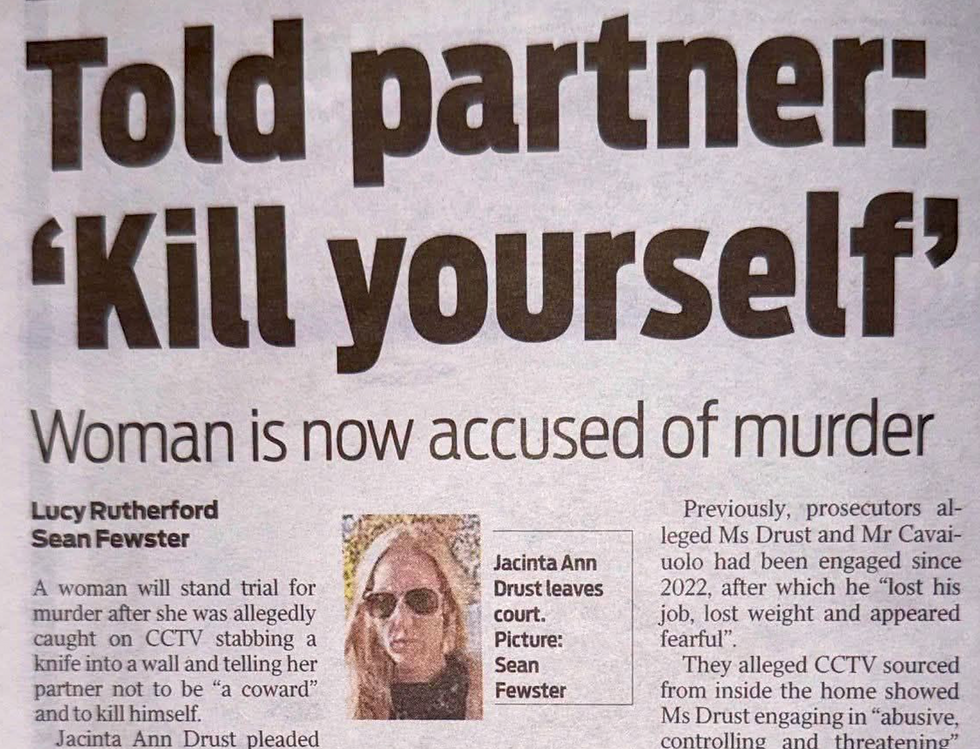
Jacinta Ann Drust, an Adelaide woman, has been charged in connection with the March 2023 death of her former partner, Antonio Cavaiuolo.
Drust has pleaded not guilty to murder and unlawful killing. The allegations against her have not been proven, and nothing in this article should be read as suggesting that she is guilty of either offence.
What is alleged
South Australian prosecutors allege that Drust pressured or coerced Cavaiuolo to take his own life.
Earlier court proceedings have reportedly heard allegations of disturbing conduct within the relationship, including that Drust stabbed a knife into a wall near Cavaiuolo’s head, verbally abused him and urged him not to be a “coward” and to kill himself.
The prosecution case reportedly concerns alleged conduct occurring between November 2021 and April 2023 at Blakeview and elsewhere.
Cavaiuolo died by suicide at his Blakeview home in March 2023.
These remain prosecution allegations. Drust disputes the case against her and is entitled to the presumption of innocence.
Why the case matters
The case is noteworthy because it potentially brings together two areas of law and public policy that are usually considered separately: domestic and family violence and suicide.
Public discussion of domestic violence has increasingly recognised that violence within intimate relationships is not confined to physical assault.
Threats, intimidation, humiliation, isolation, financial abuse, stalking and coercive or controlling behaviour can all cause serious harm. In extreme cases, psychological abuse may contribute to profound distress.
The difficult legal question is what happens when the alleged harm culminates not in a direct physical killing, but in suicide.
Criminal law ordinarily requires the prosecution to establish both the prohibited conduct and the necessary causal and mental elements of an offence. Where another person ultimately performs the act that causes their own death, questions of causation, intention and individual autonomy become particularly difficult.
That is what makes a prosecution of this nature potentially significant.
Coercive control and causation
Coercive control is often described not as a single incident but as a pattern of behaviour through which one person seeks to dominate or control another.
That creates a challenge for conventional legal systems, which are often better equipped to assess discrete events: an assault, a threat, property damage or a particular communication.
A pattern may look very different when viewed cumulatively.
At the same time, suicide is complex and rarely lends itself to simple explanations.
Establishing that one person’s alleged behaviour legally caused another person’s death is therefore a substantially different proposition from establishing that the behaviour was cruel, abusive or harmful.
A criminal court must determine liability according to evidence and the elements of the offences charged, not according to broader social narratives about domestic violence.
That distinction is crucial.
An important test of gender neutrality
The case may also attract attention because the accused is a woman and the deceased was a man.
Domestic and family violence policy in Australia has understandably been heavily influenced by the disproportionate incidence and severity of violence committed by men against women.
But the fundamental principles underlying domestic violence law should be capable of operating irrespective of the sex of the alleged perpetrator or victim.
If coercion, intimidation, threats and psychological abuse are capable of causing serious harm, they do not cease to be relevant because the alleged victim is male.
Conversely, the fact that a prosecution involves an alleged female perpetrator should not be used to make broader claims about women, just as offences committed by men should not be treated as evidence of the character of men generally.
The appropriate unit of analysis remains the individual case and the evidence.
The danger of trial by narrative
Cases involving domestic violence can quickly acquire a public narrative before the evidence has been tested.
That risk is particularly acute where allegations are emotionally confronting.
An allegation that somebody repeatedly encouraged a vulnerable partner to take their own life is inherently disturbing. But emotional reaction is not a substitute for proof.
Drust has pleaded not guilty.
The prosecution will therefore have to prove the relevant charge beyond reasonable doubt, including whatever questions of conduct, intention and causation arise under South Australian law. The defence must have the opportunity to challenge the evidence and advance its case.
The presumption of innocence is not a technical inconvenience. It is one of the safeguards that distinguishes an allegation from a judicial finding of fact.
Current status
Drust entered pleas of not guilty to murder and unlawful killing in the Adelaide Magistrates Court.
The matter is expected to proceed towards trial in the South Australian Supreme Court.
She has been granted continued home-detention bail at her Renown Park residence, and a further committal hearing has been listed for 30 November 2026.
Until the proceedings are concluded, commentary about the case should remain appropriately cautious.
A case worth watching
Whatever its eventual outcome, the Drust prosecution raises questions that extend beyond one defendant and one tragic death.
How should the law understand psychological abuse when it is alleged to contribute to suicide?
When does encouragement become coercion?
How should causation be established when a person ultimately takes their own life?
How should courts distinguish morally reprehensible behaviour from conduct satisfying the elements of homicide?
Can domestic and family violence frameworks recognise victims and perpetrators consistently when their sex does not fit the pattern most commonly represented in policy and public discussion?
Those are difficult questions.
The criminal proceedings against Jacinta Ann Drust may provide some answers. For now, however, there is an equally important principle to remember: a prosecution is not a conviction.
The allegations against Drust remain allegations, and her guilt or innocence is ultimately a matter for the court.


Comments