Three Vases, Two Standards: Accountability and Equality
At the centre of the public debate over Lindsay Clancy is an assertion about accountability: that illness after childbirth left her unable to control the actions that killed her three children. Some arguments advanced in her support invoke postpartum depression and hormonal imbalance, as discussed in the video that prompted this article. Her legal defense centered specifically on postpartum psychosis—a distinction that matters when assessing the claim. [ABC/Reuters reporting].
The diagnostic terminology also needs precision. Postpartum depression is not a standalone diagnosis in DSM-5-TR. Depression arising around childbirth is classified within recognised mood disorders, with a “peripartum onset” specifier where its criteria are met. The illness is real; the absence of a separate diagnostic category does not invalidate it. Equally, calling something postpartum depression, psychosis or a hormonal imbalance does not, by itself, establish that a person lacked criminal responsibility. [CANMAT clinical guideline].

The question is what the evidence establishes about capacity, and whether we apply the same standard to women and men. The three-vases analogy brings that question into focus.
The comparison appeared in the public defense of Clancy. A commentator supporting her lack-of-criminal-responsibility argument asked viewers to imagine the children she killed as objects broken during an involuntary seizure.
In a clip replayed on *The James Golden AKA Bo Snerdley Show* on 5 September 2026, the speaker says: “Stop thinking about these kids as people and think about them as ceramic vases for just one second for me, okay?”
She then describes Clancy as a museum visitor with epilepsy who breaks three priceless vases during a seizure. The comparison supports an argument for psychiatric hospital treatment instead of prison. The clip and its wording can be checked in the broadcast transcript, approximately 35:07–37:01.
That context matters. The analogy was being used to defend a position in a real case. Its implications deserve to be followed through.
The children behind the comparison
Clancy's children were Cora, five, Dawson, three, and Callan, eight months old. Their deaths in Massachusetts in January 2023 were the subject of three first-degree murder charges. Her defence did not dispute that she killed them; it argued that postpartum psychosis removed her criminal responsibility. Prosecutors disputed that conclusion. The trial ended in a mistrial in September 2026 after the jury could not reach a unanimous verdict. It established neither a conviction nor an acquittal. [ABC/Reuters reporting].
The museum comparison makes a distinction between deliberate damage and an involuntary act. But it cannot establish which kind of conduct occurred in Clancy's case. Describing the disputed act as a seizure builds the claimed loss of control into the story before that question has been decided.
Then comes the question the analogy leaves us with: even if the loss of control is established, what follows for everyone's safety?
The museum still needs an answer
Imagine that the visitor genuinely could not control the movements that broke the vases. Blaming those involuntary movements may make little sense. But the loss still exists, and the museum must decide what happens tomorrow.
What did the visitor know before entering the gallery? Was this a wholly unexpected first seizure, or had specific warnings about an uncontrolled condition been ignored? Those circumstances deserve separate examination. The broken vases alone establish neither negligence nor innocence.
The speaker's proposed hospital treatment is itself a response to risk. The broader problem arises if an argument about incapacity is extended into a demand for freedom from every consequence or precaution.
Suppose the visitor knows about their condition, but continues to visit museums. Damaging incidents keep recurring, and every precaution is rejected. The museums are left to absorb the losses. Eventually, they may remove valuable objects, restrict entry more broadly, or close parts of the collection. Other visitors lose access too. The cost of one person's unrestricted access has been transferred to everyone else.
There are better possibilities: protective cases, safer layouts and precautions matched to an individual's actual circumstances. Those possibilities illustrate the point. Avoiding blame does not eliminate the need to manage risk.
An explanation for the last loss is not a plan for preventing the next one.
We cannot declare someone powerless when discussing responsibility, then simply assume adequate control when discussing a credible risk of recurrence.
Other cases show why the next question matters
Constance Fisher's case makes the risk of recurrence painfully concrete. After the deaths of her first three children in Maine in 1954, a grand jury declined to indict her on grounds of insanity. She spent five years in a psychiatric hospital before release. In 1966, three more of her children died at her hands; she was subsequently found not guilty by reason of mental disease. [Associated Press retrospective].
That history cannot predict another person's behavior. It shows why a finding of blame cannot substitute for an assessment of future danger. The question of what happens after treatment has consequences beyond the person receiving it.
Andrea Yates's case illustrates a different response. After she killed her five children in Texas in 2001, her initial murder convictions were overturned. At her 2006 retrial, she was found not guilty by reason of insanity, with commitment to a state mental hospital to follow. The outcome recognised a defence while retaining a protective response. [Associated Press's contemporary report, archived by the University at Buffalo].
Lauren Dickason's case shows that mental illness does not automatically determine the verdict. A New Zealand jury convicted her of murdering her three daughters after an insanity and infanticide defence. She received an 18-year sentence in 2024, initially in a psychiatric treatment setting. Her conviction appeal has been listed for February 2027. [RNZ reporting republished by the Otago Daily Times].
These cases have different evidence, legal tests and outcomes. They do not establish Clancy's responsibility, or prove a general pattern of judicial bias. They show why we must distinguish three questions: what happened, what responsibility the law assigns, and what protection is needed afterwards.
Change the sex and keep the reasoning
Now consider the claim that a woman's harmful conduct should be excused because hormones influenced her behaviour.
Apply that principle consistently. A man kills somebody and says testosterone influenced his aggression. Would the same people accept that he therefore bears no responsibility?
If the principle is simply that hormonal influence removes accountability, the argument cannot stop at the boundary between female and male biology. Accept it for one sex and it becomes available to the other. Reject it for men and it needs a better foundation when offered for women.
This does not make ordinary testosterone levels medically equivalent to severe postpartum psychosis. It exposes the weakness of using hormones alone as the explanation that settles responsibility. The relevant issue is the person's actual mental state and capacity, assessed under the applicable law.
A biological explanation and a loss of meaningful control are different propositions. Moving from one to the other requires evidence.
The double standard appears whenever we search for reasons a woman could not help herself while treating a man's conduct as sufficient proof of his character. It also appears if we dismiss a man's genuine impairment because we are unwilling to extend to him the reasoning we accept for a woman.
Equality requires the same seriousness in both directions. Men do not lose their entitlement to a fair assessment. Women do not become exempt from one.
“Postpartum” is not a verdict
There is an important diagnostic distinction here. “Postpartum” describes the period after childbirth. It is not, by itself, a psychiatric diagnosis.
In DSM-5-TR, perinatal mood disorders do not have their own diagnostic category. Relevant disorders, including major depression and bipolar disorder, can carry a “with peripartum onset” specifier. Postpartum psychosis is also not a separate DSM diagnosis; psychotic episodes can be classified within other disorders. [CANMAT clinical guideline]; [review of postpartum psychosis and DSM classification].
This distinction does not make the illnesses unreal. It means that the word “postpartum” cannot do all the work of identifying an illness, establishing what caused a particular act and deciding legal responsibility.
Nor does absence of a separate DSM label dispose of a defence. Massachusetts' model instructions, for example, expressly distinguish the legal concept of mental disease or defect from a formal medical diagnosis. They focus on the relevant loss of capacity and place the burden of establishing criminal responsibility on the prosecution when the issue is raised. [Massachusetts model jury instructions].
The argument for equality is stronger when it insists on that examination, rather than allowing either a diagnostic label or its absence to become a shortcut to the outcome.
We already understand this in aviation
A pilot does not have to be morally at fault for a seizure to create an unacceptable danger in flight.
That is why aviation assesses the risk before permitting the activity. Australia's Civil Aviation Safety Authority requires medical assessment of a seizure history, including its cause and relevant records. Eligibility depends on the circumstances and certification requirements; it is not a universal lifetime ban on everyone who has ever had a seizure. [CASA, Medical Assessment for Aviation, section 9.3.3].
The principle is straightforward: a person may be blameless for an illness while still requiring precautions when that illness creates a particular danger to others.
A museum, an aircraft and a family plainly involve different risks and rights. The precautions will differ. But foreseeable harm still needs an answer in each setting.
If a parent's condition creates an evidenced risk of serious harm to a child, calling the condition involuntary does not resolve the safety question. The response might involve treatment, practical support, another adult's presence or restrictions appropriate to the circumstances. It must be based on the actual risk, with a route to review as circumstances change.
Children's safety cannot depend on whether adults find the parent sympathetic.
Equality includes the consequences
There is a contradiction in demanding that women be recognised as fully capable adults while explaining away their harmful conduct through sweeping assumptions about female biology. Taken seriously, the claim that women cannot control themselves would invite restrictions on their autonomy. That would undermine the equality supposedly being defended.
The better principle treats women and men as individuals whose conduct, capacity and responsibilities require the same careful examination.
In Australian parenting proceedings, the child's best interests are paramount. Relevant considerations include safety and each proposed carer's capacity to meet the child's needs. That provides a practical focus for reform: assess the behaviour, the evidence and the proposed arrangements. [Federal Circuit and Family Court of Australia].
A father's warning about a mother's conduct should be examined on its merits. So should a mother's warning about a father's conduct. Neither an allegation nor a sympathetic explanation should determine the outcome before the evidence is assessed.
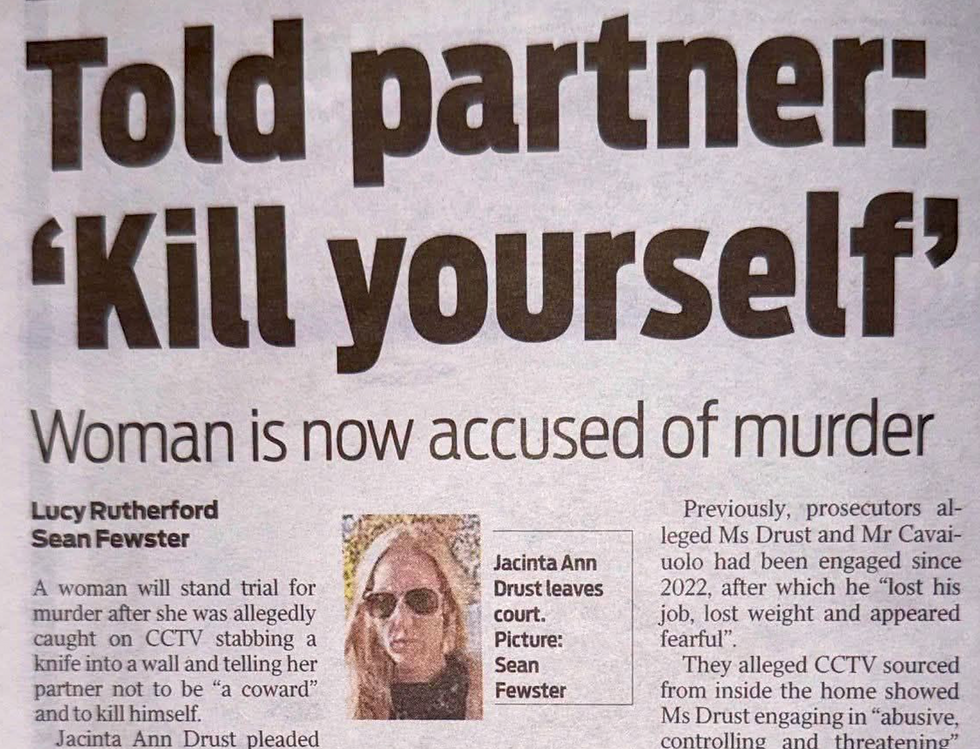
The same demand for consistency runs through this site's examination of the Jacinta Ann Drust case, which concerns contested allegations of coercive control and a male partner's death. It is a different kind of case, with allegations that remain to be determined. The connection is the principle: take possible harm seriously regardless of the sex of the alleged perpetrator or victim.
The museum analogy ultimately asks us to follow our reasoning through. If control was genuinely absent, address the implications for future safety. If someone retained the relevant capacity, assess responsibility under the same standards. If the evidence changes, change the response.
What cannot be defended is a standard that changes when we change the sex of the person involved.
The three vases remain broken, whatever story we tell about the person who broke them. Equality requires that we ask the same questions about responsibility—and about preventing the next loss—of women and men.
Source acknowledgement: The pro-Clancy museum comparison is documented in the replayed clip linked above; the speaker's original upload and identity have not been independently verified. Orion Taraban examines that comparison, and offers the testosterone and aviation examples, in Never her fault: Lindsay Clancy, particularly around 4:19–4:52 and 6:02–9:27. This article develops those arguments rather than treating the video as evidence of any person's criminal responsibility. Case references checked on 23 September 2026. General commentary, not legal or medical advice.


Comments