Fixated Threat Trajectory: A Self-Licking Ice Cream (aka When Policy Starts Citing Itself)
Australia’s national domestic violence risk principles look scientific. They contain citations, statistics and an “evidence base”. But follow some of the references far enough and an uncomfortable problem emerges: policy cites research, research cites policy, commissioned reviews cite other commissioned reviews, and propositions narrower than the policy claims are progressively transformed into national “principles”.
Australia’s National Research Organisation for Women’s Safety (ANROWS) has substantial influence over the way domestic and family violence is understood in Australia. Its work informs governments, police, courts, domestic violence services and risk-assessment frameworks used to make extraordinarily consequential decisions about people’s lives.
That makes the quality of its evidence important. Very important.
ANROWS’s National Risk Assessment Principles for Domestic and Family Violence were commissioned for the Commonwealth Department of Social Services to provide an overarching national understanding of risk and guide jurisdictions developing or revising risk-assessment frameworks. [1]
There is substantial scholarship behind parts of the document. But there is also a problem.
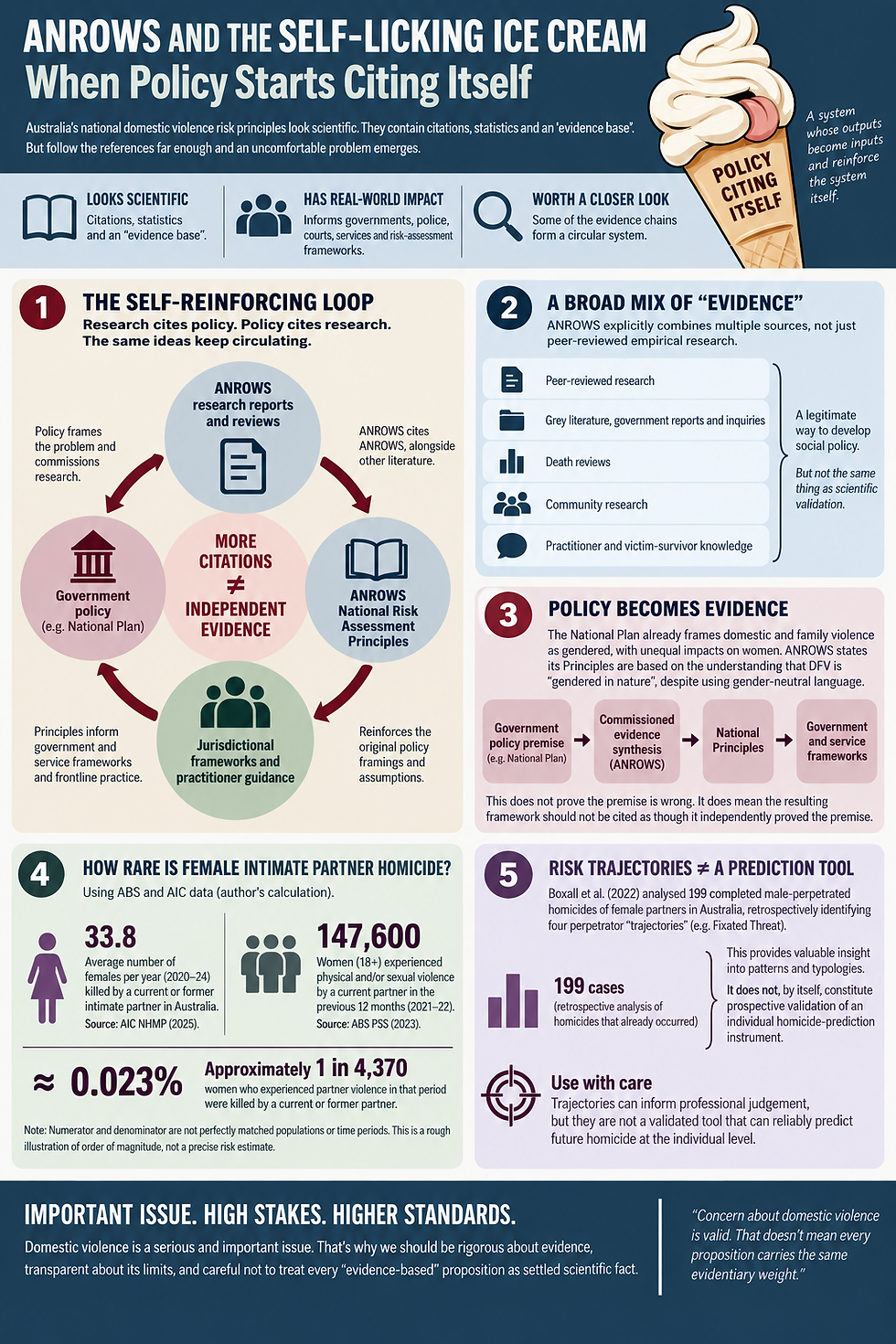
Follow the evidence chains carefully and parts of the framework begin to resemble what engineers jokingly call a self-licking ice cream: a system whose outputs become inputs that reinforce the system itself.
ANROWS publications cite other ANROWS publications. Government policy supplies propositions that subsequently inform government policy. Practitioner beliefs and commissioned reports sit beside empirical research. Findings derived predominantly from male-perpetrator/female-victim samples become principles presented for much broader application.
None of that makes the underlying concern about domestic violence invalid. It does mean we should stop treating every proposition labelled “evidence-based” as though it carries the same evidentiary weight.
Start with something ANROWS gets right
The fairest place to begin is with ANROWS’s own description of its methodology. Its companion resource does not claim to rely exclusively on peer-reviewed empirical science. It expressly combines peer-reviewed research with “grey literature”, government reports and inquiries, death reviews, community research and resources reflecting practitioner and victim-survivor knowledge. [2]
That is a legitimate way to develop social policy. It is not the same thing as scientific validation.
A systematic review, an empirical study, a government strategy, a submission to an inquiry, a service-provider survey and practitioner experience are different forms of evidence with different strengths and susceptibility to bias. Once they are blended together under the single label “evidence base”, those distinctions become difficult for downstream readers to see.
That matters because these principles do not remain academic observations. They influence real-world assessments and decisions.
The first loop: ANROWS cites ANROWS
The companion review contains genuine external academic literature. Its own reference list also includes numerous ANROWS state-of-knowledge papers, analyses, research reports and commissioned reviews. That observation comes directly from inspection of the Companion Resource and its bibliography, rather than from a separate secondary analysis. [3]
There is nothing inherently wrong with an organisation citing its own research. The problem arises when repeated citation creates the appearance of independent corroboration although the evidence chain remains within substantially the same intellectual and policy ecosystem.
ANROWS report → ANROWS evidence review → ANROWS National Principles → jurisdictional framework → practitioner guidance.
By the time a proposition reaches a frontline practitioner, it can look like settled national scientific knowledge. But the number of documents repeating a proposition is not the number of independent studies establishing it.
Citation volume is not independent replication.
The second loop: policy becomes evidence for policy
ANROWS’s National Principles were created pursuant to the National Plan to Reduce Violence Against Women and their Children. That National Plan already frames domestic and family violence and sexual assault as gendered crimes with unequal impacts on women. ANROWS then states that, although gender-neutral language is used, its Principles are based on an understanding that domestic and family violence is “gendered in nature”. [1]
So the sequence is not simply: data → hypothesis → testing → conclusion → policy.
At least part of it is: government policy premise → commissioned evidence synthesis → national principles → government and service frameworks.
That does not prove the premise is wrong. It does mean the resulting framework should not later be cited as though it independently proved the premise from which it was developed.
That is the self-referential problem.
The evidence base is narrower than the policy application
ANROWS itself acknowledges that the only strong evidence base regarding DFV risk factors is for heterosexual intimate-partner violence. Its companion resource goes further: empirically identified risk factors have almost exclusively been developed using heterosexual samples, and their applicability to other relationships remains unclear. [1][2]
That is responsible caveating. It also creates an awkward question.
If the evidence is population-specific, how confidently should it be generalised to the much broader phenomenon of “domestic and family violence”?
Family violence includes parent-child violence, elder abuse, sibling and extended-family violence, Aboriginal concepts of family violence and relationships that bear little resemblance to the heterosexual intimate-partner homicide samples from which many lethality factors were derived.
The title says domestic and family violence. Much of the strongest empirical evidence says male-perpetrated heterosexual intimate-partner violence against women. Those populations are not interchangeable.
The sampling problem and the missing denominator
ANROWS’s high-risk table draws heavily on research involving serious abuse, attempted femicide and completed homicide. For separation it cites women killed by former partners; for strangulation, women whose partners attempted to strangle them; for stalking, attempted femicides and femicides; for threats to kill and weapons, abused women exposed to those behaviours. [4]
These are legitimate and important studies. But notice the architecture: begin with serious or lethal cases and work backwards to identify characteristics that preceded the outcome.
That can establish P(risk factor | homicide). It does not, by itself, establish P(homicide | risk factor).
Take separation. ANROWS reports that 65 per cent of female victims killed by a former partner in a NSW dataset had ended the relationship within three months. [4] That tells us something important about homicide victims. It does not tell us what proportion of recently separated women are killed.
Published Australian data provide a useful illustration of the denominator problem. The ABS Personal Safety Survey estimated that 147,600 women experienced intimate-partner violence in the preceding 12 months in 2021–22. AIC National Homicide Monitoring Program data record 40, 33, 35, 36 and 25 female intimate-partner homicide victims in the five years from 2016–17 to 2020–21, an average of 33.8 per year. Dividing that five-year homicide average by the ABS annual IPV estimate gives approximately 0.023 per cent, or about 1 in 4,370. This is the author’s broad population-level calculation from published ABS and AIC data; it is not a validated individual prediction and the numerator and denominator are not perfectly matched populations or periods. [5]
That is a crude population-level calibration, not an individual prediction. The point is not that homicide risk is unimportant. The point is that relative risk and absolute risk answer different questions. A competent risk system needs both.
When different kinds of evidence are treated as though they were equivalent
ANROWS’s treatment of intimate-partner sexual violence is revealing. The companion resource cites the ABS Personal Safety Survey finding that 5.1 per cent of Australian women had experienced sexual violence by a partner since age 15. It then reports that domestic violence workers believed that 90–100 per cent of their female clients had experienced intimate-partner sexual violence. [2]
Those are profoundly different types of evidence. One is national survey data. The other is a report of service-provider belief about a selected client population.
Practitioner belief can provide valuable qualitative insight and generate research questions. It is not a prevalence measurement. Placing it beside population statistics without sharply distinguishing its epistemic status risks turning professional belief into apparent epidemiology.
Suicide becomes “control”
Another example appears in the risk-factor table. ANROWS states that threats of suicide, like most threats in the DFV context, are a strategy used by perpetrators to exert control. The same section notes that 24 per cent of men who killed an intimate partner in NSW between 2000 and 2014 died by suicide following the murder. [4]
The second proposition does not establish the first.
A perpetrator dying by suicide after homicide does not establish that an earlier suicide threat was deliberately coercive. Suicide threats can certainly be manipulative in some cases. But suicidality can also reflect depression, despair, intoxication, acute crisis or genuine suicidal intent.
Those constructs should be distinguished, not collapsed into a predetermined perpetrator narrative.
Court proceedings illustrate the same problem
ANROWS also lists “Court orders and parenting proceedings” among other risk factors. Its guide reports that, from their experience, victim-survivors considered family-law proceedings and intervention orders an important and overlooked indicator of DFV risk, and states that perpetrators may use parenting roles or judicial options to exercise control. [4]
Again, that may happen. But the evidentiary progression matters: reported experience → review literature → national risk factor → operational assessment.
Where is the base rate? What is the effect size? How sensitive and specific is the factor? How often do separating parents engage in court proceedings without subsequent violence? What incremental predictive value does the factor add after controlling for separation and prior violence?
Those are risk-science questions. The framework does not answer them.
Indicative is not predictive
ANROWS’s own documents contain an important tension. The companion resource quotes the proposition that risk assessment is “an art rather than a science” and should be preventive rather than predictive. Elsewhere it warns that risk factors are “indicative not predictive”. [2]
Yet the same system repeatedly uses the language of likelihood, high risk and lethality.
That creates semantic slippage when the material moves into practice. A risk factor becomes a tick on a form. Several ticks become “high risk”. “High risk” enters a service letter. A police officer, lawyer or magistrate reads it, and what began as a population-level association can acquire the appearance of an individual prediction.
A risk-management tool can be useful without being a prediction instrument. But that distinction must survive contact with practice.
The framework calls for validation. So where is it downstream?
ANROWS says structured professional judgement may draw on a well-tested actuarial risk tool, professional judgement and information from other sources. Its companion review refers to tools with strong predictive validity or evidence-based risk factors. [2][4]
That is sensible. It also raises the questions any operational system built from these principles should answer:
What are its sensitivity and specificity? What are its positive and negative predictive values? What are its false-positive and false-negative rates? What is its inter-rater reliability? Do two trained practitioners assessing the same case reach substantially the same conclusion? Does the system improve outcomes compared with plausible alternatives?
The National Principles are principles, not themselves a scoring instrument, so it would be unfair to demand predictive statistics from them as though they were one. The narrower criticism is stronger: literature-supported factors do not automatically validate a downstream decision system that operationalises them. That validation must occur at the tool and practice level.
The “Fixated Threat” trajectory shows where this can lead
ANROWS’s later “fixated threat” work makes the problem particularly visible.
The underlying project analysed 199 completed male-perpetrated intimate-partner homicides and retrospectively identified recurring trajectories. About one-third of the analysed cases were classified as “fixated threat”. [6]
That can be useful retrospective research. It is not a validated prospective homicide-prediction instrument.
The study begins with people known to have committed homicide. Using the resulting typology to label a living person as being “on” a homicide trajectory reverses the conditional probability again.
The fact that some murderers displayed behaviour X does not establish that a person displaying X is likely to become a murderer.
Those limitations follow from the design and stated scope of the published research itself. Boxall et al. analysed 199 completed homicides in which a male offender killed a female intimate partner and retrospectively classified recurring pathways. The study describes offender trajectories and potential intervention points; it does not report prospective validation showing that the “fixated threat” trajectory can predict homicide in an individual living person. That distinction is methodological analysis of the published study, not a separate empirical finding. [7]
Once a descriptive construct migrates into frontline practice, a phrase such as “following a Fixated Threat intimate partner homicide trajectory” can sound remarkably like a forensic conclusion.
It isn’t.
The confirmation-bias machine
Now put the pieces together.
A framework derived substantially from retrospective cases tells practitioners which characteristics to look for. Practitioners ask questions designed to identify those characteristics. Service records document them. Death reviews and later research analyse those records. The research finds the characteristics the system was already structured to record. The findings feed into the next generation of frameworks.
That is not necessarily fabrication. It is something subtler: a potentially self-reinforcing measurement system.
Unless independent validation, comparison groups, competing hypotheses and error measurement interrupt the loop, the system can become increasingly confident in propositions partly generated by its own architecture.
That is the real self-licking ice cream.
The missing question: how often is the system wrong?
The ultimate test of a risk-assessment system is not whether its principles sound plausible. It is whether it works.
ANROWS correctly warns that inconsistent and fragmented responses can have fatal consequences. [2]
But false positives also have consequences. So do misidentification, unnecessary intervention, removal from homes, damaged parent-child relationships, employment consequences, criminalisation and psychological harm.
A serious risk system should therefore measure both sides of the error equation.
How many dangerous cases were missed? How many low-risk cases were classified as high risk? How often was the predominant aggressor wrongly identified? How often do two assessors reach the same conclusion? What changes when independent evidence is added? What proportion of high-risk classifications are followed by the outcome of concern?
Those questions are not attacks on domestic violence prevention. They are what risk management looks like.
ANROWS’s own Principle 9 describes risk factors as variables assisting assessment of the likelihood that violence will recur or escalate and refers to determining a risk threshold. [4] Once a system uses terms such as likelihood, high risk and threshold, measurement is not optional.
It is the difference between risk assessment and professional intuition dressed in risk terminology.
A citation chain is not independent evidence
Suppose Document A makes a proposition. Document B cites A. Document C cites B. A government framework cites C. A practitioner guide cites the framework.
Five documents now contain the proposition. There may still be only one underlying evidentiary source.
If that source was policy, practitioner opinion or a qualitative study, repetition can gradually obscure what the proposition originally rested upon. It acquires citation authority: it looks established because it appears everywhere.
That is why evidence synthesis should distinguish primary empirical evidence, replication, systematic review, expert synthesis and policy judgement.
ANROWS expressly mixes peer-reviewed research with government reports, inquiries, death reviews, community research and practitioner and victim-survivor knowledge. [2] That is not inherently illegitimate. The weakness arises when the resulting propositions are flattened into the single description “evidence-based”.
Cherry-picking does not require inventing a statistic
Selection bias does not require a false number.
Homicide research understandably asks what characteristics were present among people who were killed. A prospective risk system must also ask how common those characteristics are among the vastly larger population in which homicide does not occur.
Without that denominator, an association can sound far more predictive than it is.
The job of an effective risk-assessment system is not merely to identify characteristics commonly found retrospectively among homicide cases. It is to discriminate between the relatively small number of genuinely dangerous cases and the much larger number of people who share some risk markers but will never commit homicide.
That requires prospective validation, calibration and error measurement.
What a genuinely evidence-based system would require
A stronger national framework would retain well-established behavioural risk factors while imposing much tougher standards on how they are translated into decisions.
Every major risk factor should be traceable to primary evidence. The evidence hierarchy should be explicit. Peer-reviewed empirical studies should be distinguished from systematic reviews, government reports, practitioner opinion, lived experience and policy judgement.
Population-specific findings should remain population-specific unless generalisation is independently supported.
Absolute risk should accompany relative risk wherever reasonably possible.
Operational instruments should publish sensitivity, specificity, positive predictive value, negative predictive value and known limitations. Inter-rater reliability should be measured. False positives should be studied alongside false negatives. Misidentification should be treated as a safety failure.
Most importantly, frameworks and tools should be independently validated by researchers who did not design them.
That is how a self-referential system becomes a learning system.
This is not an argument against ANROWS
ANROWS performs an important function. Its publications contain valuable research, and many propositions in the National Risk Assessment Principles have credible empirical support.
Nor is the argument that government-funded research is inherently compromised, practitioner knowledge is worthless or lived experience should be excluded.
The issue is narrower.
Evidence must retain its identity as it moves through the system.
A qualitative observation should remain a qualitative observation. Practitioner experience should remain practitioner experience. A government policy assumption should remain a policy assumption. A retrospective association should remain a retrospective association. A validated predictor should be called a predictor only to the extent that validation supports it.
And uncertainty should remain visible.
The trouble begins when all of them arrive at the other end labelled simply: EVIDENCE-BASED.
The self-licking ice cream
The danger with a closed policy-research ecosystem is simple.
Policy commissions research. Research adopts policy assumptions. Research cites earlier research produced within the same ecosystem. The synthesis informs new policy. Policy determines what practitioners look for. Practitioners generate records reflecting those categories. Researchers analyse the records. The findings confirm the categories.
And around we go.
More reports. More citations. More confidence.
But not necessarily more independent evidence.
The cure is not ideological warfare. It is ordinary scientific discipline: independent replication, transparent data, denominators, comparison groups, competing hypotheses, prospective validation, published error rates and a willingness to discover that an attractive hypothesis was wrong.
Those are not unreasonable demands of a system that influences decisions about removing people from their homes, restricting contact with children, suspending licences, commencing legal proceedings and identifying people as potentially lethal threats.
They are the minimum we should expect.
The question ANROWS should welcome
There is a simple test of whether this criticism is hostile to domestic violence prevention or supportive of it.
Ask what happens if the criticism is correct.
If Australia’s risk frameworks contain poorly calibrated factors, circular evidentiary chains, unmeasured error rates or propositions applied beyond the populations in which they were established, correcting those weaknesses should produce better identification of genuinely high-risk cases.
Fewer false positives. Fewer false negatives. Less misidentification. Better allocation of scarce resources. Better protection for genuine victims.
That is not weakening domestic and family violence prevention. That is improving it.
Evaluation cannot mean asking only whether practice conforms to the framework. Eventually, somebody has to ask whether the framework conforms to reality.
Until Australia does that rigorously and independently, the risk remains that we have built an impressive body of policy that repeatedly cites itself, validates itself and then points to its own repetition as evidence of consensus.
A self-licking ice cream may be clever.
It is not a scientific method.
Read the evidence and decide for yourself
The detailed evidence behind this critique, the broader analysis of Australia’s domestic and family violence risk architecture, and a proposed alternative risk-management approach are available free at dfvrisk.com.au.
There you can download A System That Cannot See Itself: The Technical Volume, the shorter public edition, and The Risk Handbook for Domestic and Family Violence.
The objective is not to replace one ideology with another. It is much less exciting than that.
Measure what works. Measure what fails. Measure the errors. Publish the results. Then change the system when the evidence says we should.
Source notes
[1] Toivonen, C. & Backhouse, C. (2018), National Risk Assessment Principles for domestic and family violence, ANROWS Insights 07/2018.
[2] Backhouse, C. & Toivonen, C. (2018), National Risk Assessment Principles for domestic and family violence: Companion resource, ANROWS Insights 09/2018.
[3] Backhouse, C. & Toivonen, C. (2018), National Risk Assessment Principles for domestic and family violence: Companion resource, ANROWS Insights 09/2018. See the report’s reference list; the statement in the text is based on direct inspection of that bibliography.
[4] Toivonen, C. & Backhouse, C. (2018), National Risk Assessment Principles: Quick Reference Guide for Practitioners, including the high-risk factor tables.
[5] Australian Bureau of Statistics (2023), Personal Safety, Australia, 2021–22, including the estimate that 147,600 women experienced intimate-partner violence in the previous 12 months; and Australian Institute of Criminology, Homicide in Australia 2020–21, Table A8, reporting female intimate-partner homicide counts by year. The approximately 0.023% (about 1 in 4,370) figure in the text is the author’s calculation from those published data and is presented only as broad population-level calibration, not as an individual prediction.
[6] Boxall et al. (2022), The Pathways to Intimate Partner Homicide project: Key stages and events in male-perpetrated intimate partner homicide in Australia, ANROWS/AIC.
[7] Boxall, H., Doherty, L., Lawler, S., Franks, C. & Bricknell, S. (2022), The “Pathways to Intimate Partner Homicide” project: Key stages and events in male-perpetrated intimate partner homicide in Australia, ANROWS/Australian Institute of Criminology; and ANROWS (2022), Pathways to intimate partner homicide: The “fixated threat” offender trajectory [Fact sheet]. The methodological observations in the text are the author’s analysis of the study design and stated scope.



Comments